

DLT Registration Guide for Bulk SMS & Voice Campaigns
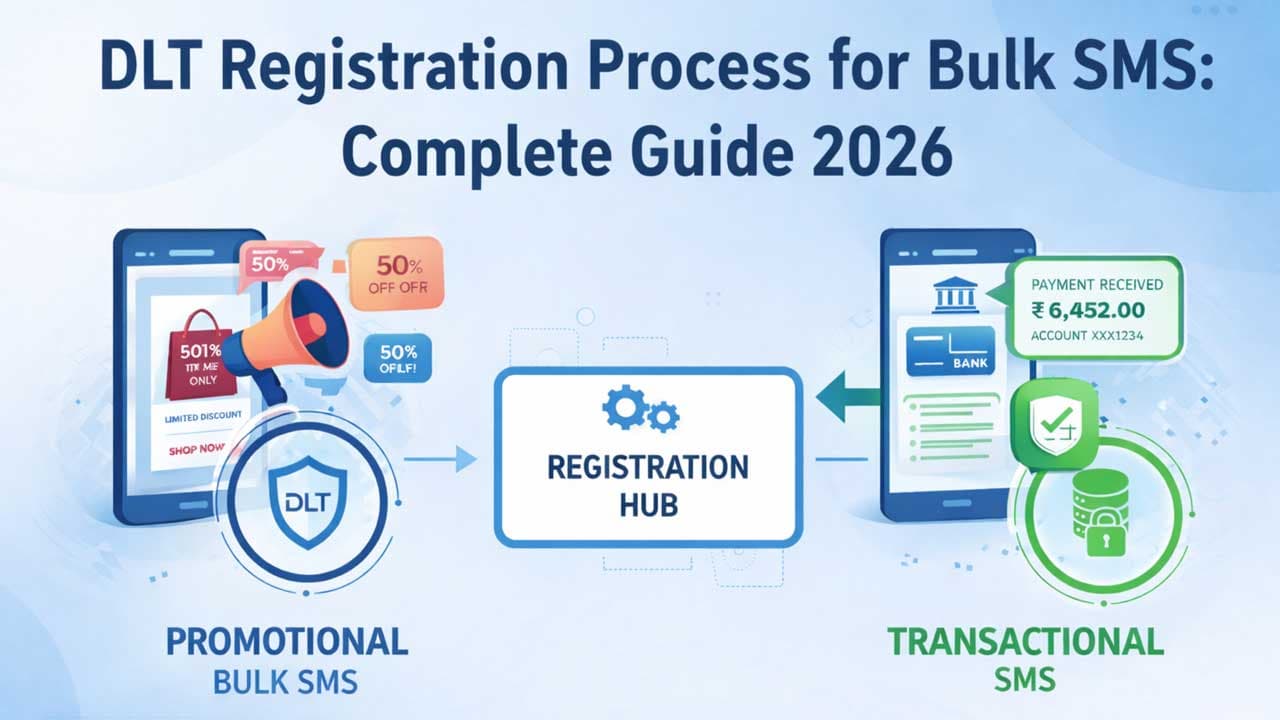
DLT Registration Guide for Bulk SMS & Voice Campaigns
Any business sending promotional or transactional SMS and voice OBD messages in India must be registered on the DLT (Distributed Ledger Technology) platform mandated by TRAI. Skip it, and even a perfectly written message gets silently dropped by the telecom operator before it ever reaches a customer.
The process starts with registering as a Principal Entity on your telecom operator's DLT portal, verified against your business PAN and GST documents. Next comes Header (Sender ID) registration - the short alphanumeric code recipients see as the sender - followed by Content Template registration, where every message format you plan to send is submitted with exact variable placeholders.
Precision matters here: even a mismatched space or punctuation mark between the registered template and the message actually delivered is enough to get it blocked. Getting templates right the first time avoids failed deliveries later, especially for time-sensitive sends like OTPs and order alerts.
A perfectly written SMS is worthless if its template was never registered on DLT - the network simply won't deliver it.

Businesses running voice OBD campaigns face the same scrutiny as SMS. Registering headers and templates upfront - before a campaign goes live - is what keeps delivery rates high when it matters most.
Step 1: Principal Entity Registration
Every business sending commercial SMS or voice OBD must first register as a Principal Entity on the DLT platform, using PAN and GST documents to verify the business. This is a one-time registration per entity - it doesn't need to be repeated for every telecom operator or every new campaign, and once approved, it's the foundation every header and template registration is checked against.
The entity record is also what ties your registration to your business specifically, rather than to whichever CPaaS vendor you happen to be using - which is why switching providers later doesn't mean starting DLT registration from zero.
Step 2: Header (Sender ID) Registration
A header is the short alphanumeric code - like "TLOPED" - that appears as the sender on a recipient's phone. Each header is registered against your Principal Entity and categorized as either transactional or promotional, which determines what kind of content it's allowed to carry and when it can send.
A common mistake is assuming a single header can be freely used for both transactional and promotional content. Telecom operators check this at the network level, so a promotional message sent from a transactional-only header gets filtered regardless of how well the template itself is written.
Want to see this working for your own business before you read further?
Step 3: Content Template Registration
This is the step where the actual message wording gets locked in. Every template - an OTP, an order confirmation, a promotional offer - is submitted with exact variable placeholders (like {#var#}) marking where dynamic content such as a name or order number will be inserted at send time.
The template registered and the message actually sent must match exactly in structure - same static text, same number and order of variables, same overall length range. A mismatch as small as an extra space or a longer-than-expected variable value is enough for the network to silently drop the message.
Common Reasons Templates Get Rejected Or Blocked
Beyond the exact-match issue above, templates commonly get blocked for: sending on the wrong header category (promotional content on a transactional header), URLs or phone numbers that weren't declared during template submission, and content that reads as promotional even when submitted under a transactional label - operators do check for this, not just the DLT platform.
Getting this right the first time matters more for time-sensitive sends. An OTP template that gets blocked mid-campaign doesn't just delay a message - it can lock a customer out of a login or checkout flow entirely.
How Long Does DLT Registration Actually Take
Entity registration is usually the fastest step once PAN and GST documents are verified. Header registration typically follows within a similar timeframe. Template approval timelines vary more, since they depend on the specific telecom operator's own review queue on the DLT portal, not just TRAI's overall framework.
This is also why handling registration through a platform that manages the process end-to-end tends to be faster in practice than navigating multiple operators' DLT portals separately - there's one submission process instead of several, and templates are checked against the exact-match requirement before submission rather than after a rejection.
Want this running for your own business? Explore our Bulk SMS or talk to our team to get started.
Frequently Asked Questions
Can I register once and use the same entity across multiple SMS providers?
Yes, your Principal Entity registration is tied to your business PAN/GST, not to a specific vendor, so it carries over if you switch or add SMS providers later.
What's the difference between a transactional and promotional header?
A transactional header can send time-sensitive content like OTPs and order alerts at any hour, while a promotional header is restricted to TRAI's permitted sending window and can't carry transactional-only content.
Does DLT registration apply to WhatsApp messages?
No, DLT registration is specific to SMS and voice OBD under TRAI's framework. WhatsApp templates go through Meta's own approval process instead.
What happens if I need to change a template after it's approved?
Any change to the wording, variable count or structure requires re-submitting the template for approval - sending a modified message against the old registration is what causes the exact-match block described above.
Ready to unify your business communication?
Most businesses are live on their own branded panel within days, not months - talk to our team today and see how fast you can start sending.
0 Comments
Be the first to leave a comment on this post.
Leave a Comment