

How WhatsApp Business API Transforms Customer Support
How WhatsApp Business API Transforms Customer Support
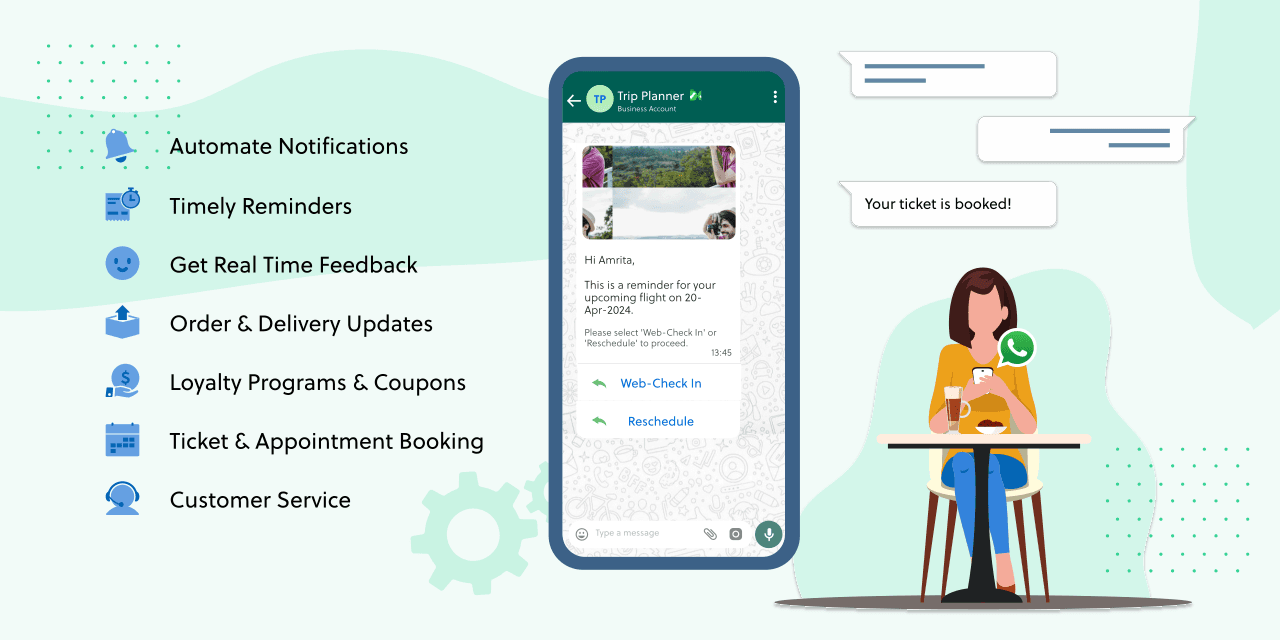
Customers now expect the same speed and convenience from support teams that they get from chatting with friends and family. The WhatsApp Business API lets brands meet that expectation directly inside the app customers already have open, replacing slow email threads and hold-music calls with real-time, two-way conversations.
A verified green-tick profile builds instant trust, while automated flows handle routine questions - order status, delivery updates, refund requests - so human agents can focus on the conversations that actually need a person. Combined with rich media messages, quick-reply buttons and list templates, support teams can resolve issues in fewer messages and with far less back-and-forth than a traditional call or email.
For businesses running SMS and voice campaigns alongside WhatsApp, staying compliant matters just as much as staying responsive. Templates and sender IDs registered on the DLT platform keep bulk SMS and OBD campaigns running without being blocked, while RCS adds a richer, branded alternative to plain SMS for customers on supported devices - with fallback rules you configure for each use case.
The channel with the fastest reply time wins the customer's attention - and today, that channel is WhatsApp.

Bringing WhatsApp, RCS, SMS and voice together under one messaging strategy - each compliant, verified and automated where it counts - is how modern support teams cut response times without growing headcount.
Why Response Time Decides Whether You Keep A Customer
A customer waiting on an email reply has no visibility into whether anyone has even seen their message. The same customer messaging on WhatsApp sees a read receipt within seconds and expects a reply on a similar timescale, because that's the standard set by every other conversation in their inbox. Support teams that don't meet that expectation lose the customer's attention to whichever competitor replies first - often before the original ticket has even been triaged in a traditional helpdesk queue.
This isn't just a perception problem. Faster first response correlates directly with resolution speed, because a conversation that starts promptly stays a single continuous thread instead of turning into three separate follow-up emails spread across a day.
What Automated Flows Actually Handle vs. What Needs A Human
The value of automation isn't replacing agents - it's filtering what reaches them. A well-built flow handles the questions that don't require judgment: "where is my order," "what's your return policy," "has my payment gone through." These are lookups against existing data, not conversations that need empathy or a decision.
What a flow should never attempt is a genuine complaint, a request that falls outside policy, or anything where the customer is clearly frustrated. Handing those off cleanly - with the flow's context intact, so the customer doesn't have to repeat themselves - is what separates automation that reduces workload from automation that just adds a frustrating extra step before a human gets involved.
Want to see this working for your own business before you read further?
Rich Media And Templates Turn A Text Thread Into A Storefront
A plain SMS can share a link; a WhatsApp message can show the product image, the price, a quantity selector and a checkout button in the same bubble the customer is already reading. For order confirmations, that means a shipping map instead of a tracking number; for support, it means a document attachment instead of a callback to "check your email."
Template messages - pre-approved formats used to start a conversation, like an order update - work alongside free-form session replies sent within 24 hours of a customer's last message. Getting this pairing right is what lets a business proactively notify a customer (via template) and then hold a natural back-and-forth conversation (via session messages) without switching tools.
Where WhatsApp Fits In A Multi-Channel Support Strategy
WhatsApp works best as the primary channel for customers who have it installed and have opted in - but it isn't the only channel a support strategy needs. RCS offers a similar rich experience for customers WhatsApp doesn't reach, with automatic SMS fallback for devices that support neither. Voice remains the right choice for the handful of situations that are genuinely too urgent or too sensitive for text.
Businesses that treat these as one connected system - not four separate vendor relationships - are the ones that actually see the response-time gains discussed above, because a message that fails on one channel doesn't just disappear; it moves to the next one automatically. That's the core idea behind an omnichannel messaging platform, and it's worth understanding before scaling WhatsApp in isolation.
Want this running for your own business? Explore our WhatsApp Business API or talk to our team to get started.
Frequently Asked Questions
Do I need a developer to set up automated WhatsApp flows?
Most routine flows - FAQs, order status, lead capture - can be built with a no-code flow builder. Custom logic tied to your own systems, like a live inventory check, typically needs a developer to wire up the API call.
How is a template message different from a regular WhatsApp message?
A template message is pre-approved by Meta and used to start a conversation - like an order update sent out of the blue. A session message is a free-form reply sent within 24 hours of the customer's last message, and doesn't need pre-approval.
Can WhatsApp support handle multiple agents on one number?
Yes, a shared team inbox lets multiple agents work from the same verified WhatsApp number, with conversations assigned so two people don't reply to the same customer at once.
What happens if a customer messages outside business hours?
An automated flow can acknowledge the message immediately and either resolve it directly (for common questions) or set expectations on when a human will follow up, so the customer isn't left wondering if the message went through.
Ready to unify your business communication?
Most businesses are live on their own branded panel within days, not months - talk to our team today and see how fast you can start sending.
0 Comments
Be the first to leave a comment on this post.
Leave a Comment