
SMS Pricing in India: API, Transactional & Bulk SMS Costs
SMS pricing in India varies by SMS type, provider, destination, message volume, sender/template requirements, DLT-related requirements, API/platform charges and taxes. Transactional, OTP and bulk/promotional SMS commonly run on different routes with different rules, which is why one flat rate rarely tells the whole story.
This page breaks down what actually drives SMS cost in India, so you can evaluate a provider's quote properly - not just compare a single headline number.
On this page:
What determines SMS cost, by message type and route
DLT, segmentation, delivery reports and volume-based pricing
A neutral provider comparison framework and cost formula
Cost considerations by industry, plus FAQs
How Much Does SMS Cost in India?
SMS cost in India isn't one number - it depends on the type of SMS you're sending and several factors layered on top of the base message rate. In practice, total cost is shaped by:
SMS Type
Transactional, OTP, and bulk/promotional SMS are typically billed on different routes with different rules.
Provider
Each provider sets its own rate and platform fee on top of network-level costs.
Destination
Domestic vs international SMS, and the specific circle/operator mix, can affect rate.
Message Volume
Higher volume can shift which pricing model (pay-as-you-go vs monthly) makes sense.
Sender/Template Requirements
Sender ID registration and DLT-approved templates are prerequisites for sending to Indian numbers.
DLT-Related Requirements
Entity and template registration on TRAI's DLT platform carries its own cost, separate from the per-message rate.
API/Platform Charges
What a provider charges for the API, dashboard, delivery reports and support.
Taxes
GST applies to provider invoices in India.
SMS Pricing in India Explained
SMS pricing in India covers more than a single per-message rate. It's the combination of the network-level cost of delivering a message, whatever a provider charges for API access, dashboard and support, and the DLT/template registration overhead specific to sending SMS to Indian numbers. This page is about that structure - for what an SMS API actually does and how it's built, see SMS API, and for OTP-specific delivery, see OTP SMS API.
SMS Pricing By Message Type
Transactional SMS Pricing
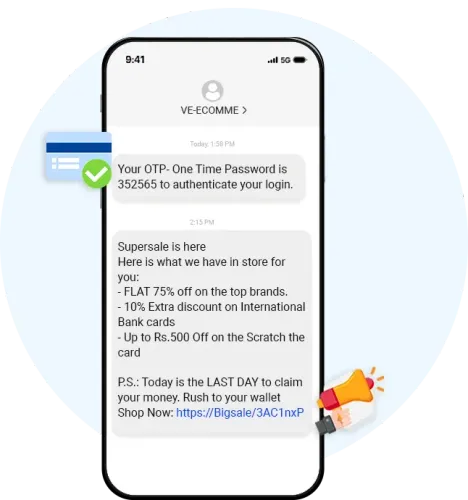
Transactional SMS - order alerts, account notifications, service messages - can be sent any time without recipient opt-in, and runs on a dedicated transactional route. Cost here tracks real business events rather than campaign size. See Transactional SMS API for the workflow behind this.
OTP SMS Pricing
OTP delivery runs on the same transactional infrastructure and DLT-registered templates, typically treated as a focused, high-priority sub-case of transactional SMS. See OTP SMS API for delivery, retry and timeout handling specific to OTPs.
Bulk SMS Pricing
Bulk sending - whether transactional or promotional - is where volume-based pricing matters most, since cost scales directly with the number of messages sent. Providers often structure rates or plans differently once volume crosses certain thresholds.
Promotional SMS Considerations
Promotional SMS only reaches opted-in numbers within TRAI-permitted sending hours, and runs on a separate promotional route from transactional traffic. Because of the opt-in and timing restrictions, promotional campaigns need the same DLT-registered template discipline covered in DLT Compliant CPaaS.
SMS API & Gateway Pricing
The underlying message rate is only part of what an SMS gateway charges for. Sending through Teleopedia's API uses the same REST pattern documented for every channel:
POST /sms/messages
{
  "to": ["+919876543210", "+919812345678"],
  "sender_id": "TLPEDA",
  "dlt_template_id": "1707162XXXXXXXXX",
  "message": "Your order #BL123456 has shipped."
}
What a gateway charges beyond the per-message rate typically includes API access itself, dashboard and contact management, delivery-report and webhook infrastructure, and support - the same components covered in the platform-charges breakdown further down this page.
DLT & Template Considerations
Sending SMS to Indian numbers requires entity and template registration on TRAI's Distributed Ledger Technology (DLT) platform - a regulatory requirement, not a provider feature. DLT itself carries nominal registration fees, and this is separate from whatever a provider charges to manage that process on your behalf.
Ask any provider whether DLT registration support is bundled into onboarding or billed as a separate line item - see DLT Compliant CPaaS for how the registration process itself works.
SMS Length & Message Segmentation
SMS is billed in segments, and message length determines how many segments a single message uses:
Plain Text (GSM-7)
Up to 160 characters per segment for a single message; longer messages are split into concatenated segments of up to 153 characters each, and billed per segment.
Unicode (Non-Latin/Emoji)
Up to 70 characters per segment for a single message, or 67 per segment when concatenated - using emoji or non-Latin scripts switches the whole message to this narrower limit.
A message that unexpectedly crosses a segment boundary - often from an unplanned emoji or special character - is billed as two messages instead of one, so this is worth checking in your own templates.
Want A Quote For Your Actual SMS Volume?
Share your expected message types and volume, and our team will walk you through the real cost breakdown.
Delivery, Volume & Billing Models
Delivery Report Considerations
Sent, delivered and failed status per message is either included in a provider's base plan or offered as a deeper reporting tier - worth confirming, since delivery visibility affects how you diagnose cost-wasting failed sends.
Volume-Based Pricing
Higher sending volume commonly shifts what pricing structure makes sense - a provider may offer a better per-message rate, or a flat plan, once volume crosses a certain threshold. The right comparison point is your own expected volume, not a generic rate card.
Monthly vs Pay-As-You-Go Models
A flat monthly or subscription fee can make sense for steady, predictable volume, while pay-as-you-go often suits lower or spikier sending patterns. Neither model is inherently cheaper - it depends on how closely your actual usage matches what you'd be paying for.
Platform/Provider Charges
Whatever a provider charges for the API, dashboard, webhooks, delivery reports and support sits on top of the underlying message rate - the same distinction that applies across every channel Teleopedia offers.
SMS Pricing Comparison Framework
We won't claim to be the cheapest or rank other SMS providers here - what follows is a neutral checklist for comparing any provider, including us, on your own terms.
| Cost Factor | What Businesses Should Check |
|---|---|
| Message rate | Per-message rate by SMS type (transactional, OTP, promotional) |
| Volume | Whether rates change at higher sending volume |
| SMS type | Separate handling/routes for transactional vs promotional |
| API access | Included in the base plan, or billed additionally |
| DLT/template handling | Registration support included or a separate service |
| Sender ID | Setup process and whether it's a one-time or recurring cost |
| Delivery reports | Included reporting depth, or a paid tier |
| Webhooks | Real-time status events included or additional |
| Dashboard | Campaign/contact management included in the plan |
| Support | Support level and response-time commitments |
| Setup fees | Onboarding or account-setup charges, if any |
| Monthly fees | Flat platform fee versus pure pay-as-you-go |
| Taxes | GST or other taxes applied to invoices |
How To Estimate SMS Communication Cost
Estimated SMS communication cost (conceptual formula)
billable SMS volume × applicable SMS rate + platform/provider charges + applicable taxes
Actual rates depend on your provider, SMS type and current pricing - always verify current figures rather than assuming a rate quoted elsewhere still applies.
SMS Pricing By Industry
The rate itself isn't industry-specific - message volume and type are what actually drive cost.
SaaS
Login OTPs, billing alerts and account notifications - volume tracks active account count more than campaign size.
Fintech
High-frequency OTPs, payment confirmations and app-based alerts, often the largest share of a fintech's transactional volume.
Logistics
Shipment tracking and delivery-attempt notices, often the highest-volume transactional use case per shipment event.
SMS Pricing FAQs
How much does SMS cost in India?
There's no single fixed rate - cost depends on the SMS type (transactional, OTP or promotional), your provider, destination, volume, and whether DLT/template setup and platform fees are bundled in or billed separately. See the cost-estimation formula on this page.
What determines SMS cost?
SMS type, provider, destination, message volume, sender/template requirements, DLT-related requirements, API/platform charges and applicable taxes - covered in detail on this page.
Is transactional SMS priced differently from promotional SMS?
Yes, typically. They run on different routes with different sending rules - transactional SMS can be sent any time without recipient opt-in, while promotional SMS only reaches opted-in numbers within TRAI-permitted hours - and providers commonly price these routes differently.
Is OTP SMS priced differently from other transactional SMS?
OTP delivery uses the same underlying SMS API and DLT-registered templates as other transactional SMS, though a provider may apply its own rate or handling for the OTP use case specifically - confirm this with your provider rather than assuming it's identical.
Does bulk SMS get cheaper at higher volume?
Many providers offer better per-message rates as volume grows, since it changes the pricing model that makes sense - but the exact threshold and discount structure is provider-specific and should be confirmed directly rather than assumed.
Does message length affect SMS cost?
Yes. A standard SMS is billed in segments - typically up to 160 characters per segment for plain text, or 70 characters when Unicode characters (like emoji or non-Latin scripts) are used - and a longer message split across multiple segments is billed as multiple messages.
Is DLT registration a separate cost from the SMS rate?
Yes. TRAI's DLT platform involves its own entity and template registration process, which is separate from what a provider charges per message - some providers bundle DLT support into onboarding, others bill it separately.
What is a sender ID, and does it cost extra?
A sender ID is the alphanumeric header recipients see instead of a phone number. Registration is typically a one-time setup step tied to your DLT entity, though how a provider handles that cost varies.
Are delivery reports included in SMS pricing?
This varies by provider - some include delivery reports and webhooks in the base plan, others price deeper reporting as an add-on. It's one of the things worth checking in the comparison framework on this page.
Is SMS API pricing different from raw message pricing?
The message rate itself is usually the same whether sent via API or dashboard - what differs is whether the provider charges separately for API access, webhooks or higher rate limits.
Do SMS providers charge a monthly fee?
Some do, some run pure pay-as-you-go. A monthly or subscription fee can make sense at higher, steady volume, while pay-as-you-go often suits lower or unpredictable volume - which model fits depends on your actual sending pattern.
Are there setup fees for SMS API access?
This depends on the provider and plan - ask specifically about DLT registration support, sender ID setup and any onboarding charges before assuming a quoted message rate is the full cost.
Does GST apply to SMS pricing in India?
Yes, GST applies to provider invoices in India on top of the underlying message and platform charges.
What should I compare when choosing an SMS provider?
Beyond the per-message rate, check volume pricing, DLT/template handling, sender ID setup, delivery reports, webhooks, dashboard features, support level, setup fees and monthly fees - see the comparison table on this page.
How do I estimate my total SMS cost?
Multiply your expected billable SMS volume by the applicable rate for your SMS type, then add platform/provider charges and taxes separately - see the formula on this page.
Does SMS pricing vary by industry?
Not directly - the rate itself isn't industry-specific, but message volume and type (transactional-heavy vs promotional-heavy) vary a lot by industry, which is what actually drives total cost. See the industry breakdown on this page.

Ready to unify your business communication?
Most businesses are live on their own branded panel within days, not months - talk to our team today and see how fast you can start sending.