

Bulk SMS Service Provider in India
A reliable bulk SMS service provider in India handles DLT registration for you, gives you both an API and a dashboard, and shows real delivery reports - not just a count of messages you submitted.
This page covers what to actually check before picking a provider, and how Teleopedia works as one: DLT-compliant sending, campaign management, batching, scheduling, delivery tracking, and room to add WhatsApp, RCS, Email or Voice on the same account later.
On this page:
What to check before choosing a bulk SMS provider in India
Campaign management, personalization, scheduling and delivery reports
DLT and compliance requirements for legitimate bulk SMS in India
A neutral comparison with WhatsApp and RCS, plus FAQs
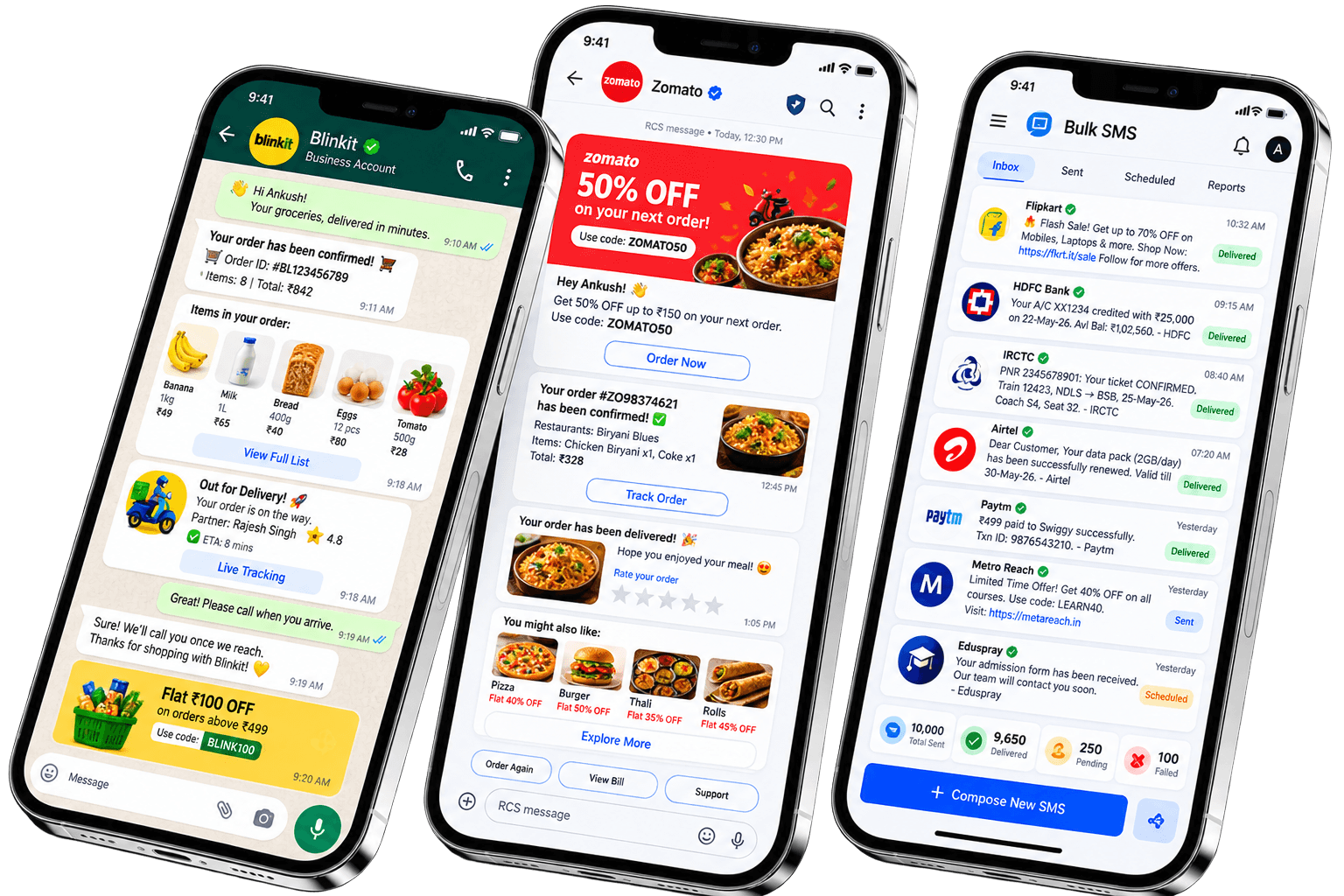
What To Check Before Choosing A Provider
SMS looks like a commodity until something goes wrong - a template gets rejected, a campaign stalls, or delivery reports don't add up. These are the things worth confirming before you commit to a provider:
DLT registration handled for you
Entity and template registration on TRAI's platform - without it, commercial SMS to Indian numbers simply won't send.
Both an API and a dashboard
Developers get a REST API; non-technical teams can still run campaigns from a panel, without waiting on engineering for every send.
Transparent delivery reporting
Per-message and campaign-level status - submitted, sent, delivered, failed - not just a 'sent' count with no visibility into what actually reached recipients.
Support for transactional and promotional routes
OTPs and account alerts need a different route, approval path and sending-hours rule than marketing campaigns - a provider should handle both correctly, not treat all SMS the same.
Room to add other channels later
WhatsApp, RCS, Email and Voice on the same account and API, so SMS isn't a dead end if your messaging needs grow.
Realistic throughput for your volume
Ask any provider for their actual batching/concurrency limits at your expected volume - don't assume a number that isn't confirmed for your account.
How Teleopedia Works As Your SMS Provider
A message moves through a consistent pipeline from your campaign to the recipient's phone:
Campaign / ApplicationTeleopedia APIValidation / QueueSMS Gateway
Carrier NetworkRecipientsDelivery Reports
Campaign Sending vs General SMS API Use
Different vendors describe this differently, and the terms "SMS blast," "bulk SMS" and "SMS campaigns" often overlap. On Teleopedia, all of it runs on the same underlying SMS API and DLT-compliant sending infrastructure - the difference below is between using that API for one-off/triggered sends versus full campaign management.
| Feature | Campaign Sending | General SMS API (Single/Triggered Use) |
|---|---|---|
| High-volume campaigns | Purpose-built campaign tooling | Supported, but not the primary framing |
| API sending | Yes | Yes |
| Campaign management | Dashboard campaign tools - lists, scheduling, reporting | Often limited to sending, not full campaign workflow |
| Scheduling | Core capability | Varies by provider |
| Batch processing | Core capability | Varies by provider |
| Delivery tracking | Per-message and campaign-level | Per-message |
| Personalization | Template variables across a large list | Template variables |
| Automation | Event-triggered bulk sends | Single or triggered sends |
How To Send A Bulk SMS Campaign
Create a campaign in your dashboard or via the API
Prepare your recipient list (upload, import or sync from a CRM)
Validate recipient data (number format, duplicates, opt-out status)
Select an approved sender ID/header
Select an approved DLT template where required
Submit messages to the API
Messages are queued and batched for sending
Monitor sending status from the dashboard or webhook
Process delivery reports as they arrive
Analyze campaign results
Campaign Management A Good Provider Should Offer
Beyond just sending, a campaign workflow covers the parts that make large-scale sending manageable:
Recipient Lists & Segmentation
Upload, import or sync lists, and segment by attributes for targeted sends.
Batching
Large lists are processed in batches rather than one giant request.
Retries
Transient failures can be retried without resending to already-delivered numbers.
Status Tracking
Per-message and campaign-level status visible from the dashboard.
Campaign IDs
Each campaign is tracked as a distinct unit for reporting.
Message IDs
Each individual message has its own ID for delivery tracking.
Why DLT Compliance Matters When Choosing A Provider
Sending high-volume SMS to Indian numbers means working within TRAI's regulatory framework, not around it. A legitimate provider handles:
DLT registration - your business entity registered on TRAI's Distributed Ledger Technology platform.
A registered sender/header - the alphanumeric ID recipients see as the sender.
Approved content templates - the exact wording and variable structure registered in advance.
Recipient consent - promotional content only reaches opted-in numbers.
Correct message classification - transactional and promotional content run on different routes with different rules, including DND and permitted-hours handling for promotional sends.
Teleopedia handles DLT entity and template registration as part of onboarding - see DLT Compliant CPaaS for how that process works in depth, and DND Compliance in India for the consumer-preference side of it.
What Businesses Use A Bulk SMS Provider For
Each use case maps to transactional or promotional rules - not every campaign is a marketing blast.
Promotional Campaigns
Offers and announcements to opted-in contacts, on the promotional route with DLT-registered templates.
Event Announcements
Launch or event updates to a segmented contact list.
Customer Notifications
Account or service updates sent to your existing customer base.
Ecommerce Campaigns
Sale announcements and cart-recovery nudges to your subscriber list.
Reminders
Appointment, payment or renewal reminders tied to a real event.
Alerts
Time-sensitive account or service alerts.
Logistics
Batch shipment or delivery-window updates across many recipients at once.
Lead Follow-Up
Batch follow-up messages to a list of recent leads or inquiries.
Comparing Bulk SMS Providers?
Tell us your expected volume and use case, and we'll walk you through DLT registration, pricing and API access.
Personalization
A campaign doesn't have to read as generic - variables inside an approved template let each recipient see relevant detail:
Customer name
Order number
Appointment date
Offer code
Personalization works within the structure of the DLT-registered template - the variable positions are approved in advance, so what changes per recipient is the value, not the template's wording or structure.
Scheduling
Campaigns don't have to send the moment you submit them:
Scheduled Campaigns
Set a future date and time for a campaign to go out.
Event-Triggered Sends
A campaign or batch send triggered by an event in your own system.
For promotional content, scheduling also needs to respect TRAI-permitted sending hours regardless of when you queue the campaign - and any recurring or time-zone-specific scheduling should be confirmed with your account team rather than assumed to be available by default.
How High-Volume Sending Is Actually Handled
Queues
Messages are queued rather than sent one at a time, so a large campaign doesn't overwhelm the sending pipeline.
Batching
Recipients are processed in batches, smoothing throughput across the campaign.
Retry Logic
Transient send failures can be retried without duplicating already-delivered messages.
Idempotency
Using a unique reference per send request helps avoid accidentally sending the same message twice on retry.
Monitoring
Campaign-level dashboards track how a large send is progressing in real time.
Rate limits and concurrency depend on your plan - check your current throughput with your account team before assuming a fixed number for capacity planning.
Delivery Reports - What A Transparent Provider Shows
Each message moves through a status lifecycle your dashboard and webhook can track:
Submitted
Accepted by the API for processing.
Queued
Waiting to be sent as part of batch processing.
Sent
Handed off to the carrier network.
Delivered
Confirmed as reaching the recipient’s device.
Failed
Could not be delivered - the report carries a reason.
Rejected
Rejected before sending, e.g. an invalid number or template mismatch.
If You Need The API: Integration Example
A campaign is submitted through the same SMS API used for any other send - an array of recipients against one template, rather than a separate endpoint:
POST /sms/messages
Authorization: Bearer YOUR_API_KEY
Content-Type: application/json

{
  "to": ["+919876543210", "+919812345678", "..."],
  "sender_id": "TLPEDA",
  "dlt_template_id": "1707162XXXXXXXXX",
  "message": "Flat 20% off today only. Shop now: yourbrand.com/sale"
}
Behind that single request: the application submits to the API, the API queues the batch, the provider layer manages sending through the carrier network, and delivery status flows back to your configured webhook - Application → API → Queue → Provider → Delivery Webhook.
SMS vs WhatsApp vs RCS As Your Primary Channel
A good provider should let you run any of these, not lock you into one - no channel is universally superior for every campaign.
| Aspect | SMS | RCS | |
|---|---|---|---|
| Reach | Virtually any active mobile number | Requires the app and opt-in | Depends on device/carrier support |
| Rich media | Plain text | Images, video, buttons | Cards, carousels, buttons |
| API | Yes | Yes | Yes |
| Campaign suitability | High-volume, low-cost-per-message broadcasts | High-engagement, conversational campaigns | Branded, visual campaigns where supported |
| Interactivity | Keyword replies only | Full two-way conversation | Buttons and quick replies |
| Fallback role | Common fallback destination | Usually primary | Primary or first fallback |
| Compliance considerations | DLT template, sender ID, consent for promotional | Template approval, opt-in for marketing | DLT-style template discipline for promotional content |
SMS As Part Of A Multi-Channel Setup
SMS commonly plays the role of a dependable fallback destination in a multi-channel setup - a business can design routing where a message tries WhatsApp or RCS first and moves to SMS under configured, business-defined rules if those channels don't complete delivery. This isn't automatic for every campaign; it's a routing setup you define per use case. See Omnichannel Messaging Fallback and Omnichannel Messaging Platform for how this routing works in depth.
Bulk SMS Service Provider FAQs
How do I choose a bulk SMS service provider in India?
Check that they handle DLT registration for you, give you both an API and a dashboard, show real per-message delivery reports (not just a sent count), correctly separate transactional and promotional routes, and are upfront about actual throughput for your volume rather than a generic claim.
Is Teleopedia a DLT-compliant SMS provider?
Yes. Every SMS template is registered on TRAI's DLT platform, and Teleopedia handles entity and template registration as part of onboarding - see DLT Compliant CPaaS for how that process works.
Do I need an API, or is a dashboard enough?
Depends on your team. A dashboard is enough for manual or occasional campaigns; an API is worth it once sending is triggered by events in your own systems (an order, a signup, a scheduled job). Teleopedia gives you both on the same account.
What's the difference between transactional and promotional SMS?
Transactional SMS confirms or informs about something a customer already did, and can be sent any time without opt-in. Promotional SMS is campaign-based, restricted to TRAI-permitted hours, and requires the recipient to have opted in. A provider should route these correctly, not treat all SMS the same.
Can I send thousands of SMS through an API?
Yes - high-volume campaigns are queued and batched rather than sent as individual one-off requests. Confirm actual batching/concurrency limits for your expected volume with your account team rather than assuming a fixed number.
What are delivery reports, and why do they matter when picking a provider?
Delivery reports show the status of each message - submitted, queued, sent, delivered, failed or rejected - so you know what actually reached recipients. A provider that only shows a 'sent' count can't tell you what actually got delivered.
Can SMS campaigns be scheduled and personalized?
Yes - campaigns can be scheduled for a future date/time or triggered by an event, and template variables (name, order number, offer code) personalize each message within the structure of an approved DLT template.
Can an SMS provider integrate with my CRM or website?
Yes, recipient lists and campaign triggers can be connected to a CRM through the API, and your backend can call the API directly to submit a campaign or trigger a batch of reminders.
Does a bulk SMS provider guarantee delivery to every recipient?
No provider can guarantee 100% delivery - outcomes depend on number validity, carrier filtering and recipient device status. What a good provider gives you is accurate per-message delivery reports, not a guarantee.
Can an SMS provider also cover WhatsApp and RCS?
On Teleopedia, yes - WhatsApp, RCS, Email and Voice run on the same account and API as SMS, so a campaign can use WhatsApp or RCS as the primary channel with SMS as a configured fallback.
Ready to unify your business communication?
Most businesses are live on their own branded panel within days, not months - talk to our team today and see how fast you can start sending.